Showing posts with label dagger. Show all posts

Sunday, February 27, 2022

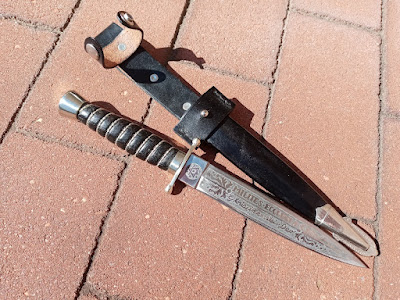
Vampire-slaying dagger

This dagger was a mini-course in processes I hadn't tried before or hadn't pushed this far.  It has a Solingen-made blade with deep saltwater etching.  The resist for this step is nail polish; I found that permanent marker and paint pen both rubbed off too easily, while the nail polish is very tough and can only be removed with a powerful organic solvent.  The original etching came out very dark, and I found it also seemed to have a little red rust despite the blade being a fairly high-chrome stainless.  (The steel-soaked q-tips also turned red very quickly.)  I sprayed the blade with Ospho to neutralize the rust, but this produced a dull coating which I had to sand off, which in turn required me to re-polish the blade, removing much of the dark patina in the process.  As a result, this now looks more like a typical acid-etched blade, which I guess isn't a bad thing.

The guard and pommel are nickel silver (the pommel is called "white brass," but I suspect that in this case, they're approximately the same thing).  I had to tap the pommel to match the unusual 10-32 blade thread - most blades of this sort are threaded 10-24.  It was excruciating, took two tries, and gave me a blood blister on one finger.  Despite my best efforts, the first pommel wound up with a badly off-center hole; the second is still slightly off-center.  The ferrule and chape are fabricated from nickel silver sheet.

For a while, I was puzzled about how to make the grip.  The tang doesn't taper until it reaches the threaded end, which makes filing out a hole very difficult and time-consuming.  On the advice of several members of BladeForums, I built an initial grip up by ripping a 1/2-inch wide section off of each of two paper micarta scales, thinning them down to match the tang's thickness, epoxying the layers together, and then attempting to turn the assembly to shape.  Unfortunately, the micarta is so smooth and impermeable that the epoxy didn't hold it together, and the assembly exploded when I tried to turn it.

In the end I used a solid wood grip and filed it out the slow way after turning.  It's American walnut, double-dyed:  first with vinegaroon, which turned it charcoal grey and ensured that no deep grooves maintained their natural color, then with Minwax ebony stain to turn it deep black.  I did not neutralize the vinegaroon; my earlier experiments showed that a subsequent baking soda rinse turns the walnut brown (and not a nice brown like it was before).  It's given linseed oil and then sealed with Tru-Oil.  The spiral wrap is silver-plated copper wire which I twisted at home.

The sheath is 4-5oz veg-tan, dry-stitched with black artificial sinew (I did not use contact cement, in order to avoid any spots which wouldn't absorb dye), dyed with Fiebings Pro Dye and finished with Resolene, neatsfoot oil and Sno-Seal.  I did not apply Resolene on the flesh side this time, and I think this prevented it from becoming too stiff.  Before stitching up the sheath, I added a screw-back button stud (nickel-plated brass).  I'd read that to prevent the button coming loose, I should put a drop of Loctite inside before screwing it together.  I used Go 2 Glue (Loctite's all-purpose formula) and only later realized that the Loctite in question was referring to Threadlocker.  Apparently Threadlocker Red 271 is the preferred type for setting the button permanently.

Due to the pommel being quite heavy for the blade, the retention strap with snap is absolutely necessary.  I haven't mastered setting the snaps so that the internal metal deforms evenly, so the snap is still slightly less secure than I'd like.  As for the double-capped rivets, they're very light; probably strong enough, but they should be domed, and without a specialized setter, hammering them to set leaves them completely flat.

The chape is the usual simple rolled cone.  I made a curved tip and ground the end of the chape to fit it, soldered it on, then ground the end smooth.  Then I cut out a drag to fit it, and etched it in ferric chloride.  Although I tried to give it a thorough resist with permanent marker, the raised areas came out rather streaky and the etch isn't very deep.  I suspect whatever formulation of nickel silver this is is more resistant to the ferric chloride than yellow brass.

Soldering the drag was also tricky, as the way the chape tapers means that the drag has to be seated on supports (I used bits of scrap brass) at a slight angle so that it will be straight relative to the chape.  The chape then had to be slid in between the supports.  I turned them both face-down and lay thin strips of solder on the back of the drag along the seams so that they wouldn't get onto the front and fill in the etching.  There are still traces of solder on the back of the drag, so I'm sure this was the right decision.

On the whole, I'm satisfied with everything except some minor imperfections.  The blade etching is definitely not as neat as the stenciled etchings of a professionally-made sword.  However, keeping in mind that the real thing would actually be damascened in silver by hand instead of etched, some raggedness is to be expected in all but the most expensive versions.  (As well, the fittings should all be a genuine albeit low-fineness silver alloy - plating would not be used, because it wears off with too many polishings.)

This is the generic type, issued to Milites Ecclesiæ members who weren't affiliated with a specific order.  With slightly altered devices, the same lodge dagger would be issued to the Ordo Fratrum Calvariæ Loci, the Sancti Societas Vampyri Catholicæ, the Legio Sīcāriōrum, and hundreds of similar chivalric orders organized under the ME.

Saturday, July 17, 2021

Garter or gambler dagger

I built this one around a German blade of unknown manufacturer or metal content which I obtained last year.  It came with a hard black coating which I've tried to sand off, although there seem to be tiny crevices in the metal that made removing all of it impossible.  I bought the guard from Crazy Crow some years ago; they seem (then and now) to use a faintly reddish brass, which is why it doesn't quite match the other fittings.  The style of small sand-cast guards they sell has changed, becoming much more rounded at the ends.

The grip is American walnut, turned to shape - the first time I have ever created a lathed handle - flattened slightly at the butt end, and with hand-filed ridges above the ferrule.  It's finished with Tried & True Varnish Oil, an old-fashioned varnish made of a mix of rosin and linseed oil such as was used in previous centuries.  I followed directions from The Muzzleloading Forum member Stophel and finished the wood with shellac, adding extra rosin dissolved in turpentine to the varnish to make the final product harder.  The varnish has to be cured outdoors in sunny weather and turned repeatedly to ensure that all sides are exposed to the sun.

The scabbard is 4-5oz. veg-tan, stitched with linen thread and dyed with several applications of cochineal steeped in alcohol.  I finished it with neatsfoot oil and then a beeswax-linseed oil blend, thoroughly buffing off excess color in between.  The fittings are all brass.  At the top is a ground-down hex nut; under it is a washer to hide the width of the tang hole (the tang is not tapered except at the threaded end) and the marks from the lathe's plum blossom bit.  I silver-soldered the ferrule, throat and chape back seams closed; the frog button is also silver-soldered in place.  I think that annealing thin sheet brass to make wrapping it around the scabbard easier also tends to lead to a sloppy appearance, and I may not do it in future.  The ferrule detailing is etched rather than embossed, so the dots and lines are flat on top and have squared edges.  Unfortunately, the staple method I devised of holding the throat in place prevents the guard from actually meeting the throat.  I will need to come up with something better in future.  Additionally, the hilt parts, throat and chape are attached with rosin-beeswax glue.

This pocket-sized dagger is roughly in the style of those made in Sheffield, England during the latter half of the 19th century, particularly (if antiques dealers may be trusted) the 1870s-1880s.  It has a very thick blade for its width, so the edges are obtuse and not well-suited for cutting.  I rarely if ever see these small daggers in frogs, so I suspect they were carried differently, but the frog button does function as a place for the thumb to push the scabbard off the blade.

Thursday, July 16, 2020

Indo-Persian letter opener

For his birthday this year, my dad asked for a letter opener.  I wonder if he didn't ask for one just because he knew it was a project I'd enjoy, but anyway, I took the first idea that came to mind and ran with it.

This is based loosely on a number of roughly 17th- to 19th-century khanjars, most often seen with curved blades but sometimes with straight ones.  It uses a Windlass full-tang dagger blade with a modified butt end.  This blade is in fact the same one as from the letter opener I made five years ago; I ordered a new one, but the new one was slightly longer and with less distal taper than the old one, and didn't fit the scabbard core I'd created.  (It, along with the large "companion" blade I ordered earlier this year, also have squared edges of around a millimeter thick, and I wonder if this is a sign of a decrease in quality control.)

Because the handle should be low-maintenance, I finished the holly grips with Tru-Oil, which, unlike linseed oil, forms a hard, glossy top coat.  The hardware is all brass.  I cut the bolsters from 3/16-inch (4.76mm) bar stock, shaped them to the correct profile with an angle grinder, polished the edges, then epoxied them in place for pinhole drilling and cross-section shaping.  I drilled flared openings to the pinholes with a Dremel high-speed cutting cone so that the pins would hopefully mushroom to fit these openings rather than forming protruding domes.  Once the pins were peened, I smoothed off the faces of the bolsters with the angle grinder, a rasp and polishing paper to produce a flush surface.

The scabbard was fairly quick to make, since I already had a wooden core on-hand fitted to this exact blade and some thin green leather, stitched with black simulated sinew.  (Velvet would be more appropriate, but regardless, most antique Indian knives I've seen have either a green or red facing material.)  I at first tried to do a cross-X stitch, but that placed so much strain on the leather that it tore and I had to replace the entire facing.

The throat and chape are sheet brass, with classic Mughal leaf decoration drawn freehand in permanent marker for a resist and ferric chloride-etched.  A soldered tab holds a suspension ring.  A few originals I've seen have a cord tied to the suspension ring, which I understand would be used for attaching the scabbard to a belt, but in this case it seems less effective because the blade is very light, causing the whole assembling to hang handle-down when tied to a belt.  This is perhaps less important in this application than it might be elsewhere, since it's unlikely that Dad will actually wear this letter opener, but it would be nice nonetheless to figure out a way to make it work anyway.  A second suspension ring on the other side of the throat might help; however, I suspect that any system which doesn't involve lashing the scabbard tightly to the belt will be ineffective on account of the balance.  The chape has a soldered brass bead for a finial, capped off at the other end with an escutcheon pin; the chape and throat are also soldered up the back.

Sunday, May 15, 2016

Presentation box for my letter opener

Yesterday I finished up my fine woodworking fundamentals course.  There were exactly two projects in this class (aside from doing a practice set of dovetail joints), a picture frame and a box.  I'm not publishing the picture frame because it's very plain and uninteresting.

I made the box to fit the letter opener I finished in September.  The finger joints reminded me of masonry, so it's obviously inspired by West Asian architecture, particularly the palaces of Persepolis.

It consists of American or black walnut and soft maple.  Unfortunately, the walnut's color varied a lot through the plank.  For finishes I had a choice of boiled linseed oil, tung oil-based varnish or water-based polyurethane, but being short on time, I was forced to go with the polyurethane, so its finish is still a bit rough (the professor noted that polyurethane, in her words, "bubbles" a lot when brushed on; it requires repeated sanding to look good).

It has two brass-plated steel hinges.  Sadly, copper to match the letter opener's furniture seems to be unavailable.  I might try to fabricate my own in the future.  The letter opener and scabbard are supported by two inserts carved from rigid pink insulating foam and covered with epoxied polyester suede cloth.  A considerable amount of epoxy seeped through the cloth; clearly I should've found something with a non-porous back.

Because the box is so small and cut to fairly tight tolerances, it's feasible to have the upper insert rest on a pair of narrow shelves over the lower one so the box can be more compact.

This was a good class for learning the use of the major standing equipment and how to get the greatest precision in fit.  Most of the work is (if you do it correctly) done on the planer, table saw and routing table, machines with which I was totally unfamiliar before.  It also gave me a chance to get started on a handful of personal projects which I can finish up over the summer.

Monday, September 28, 2015

I'm calling it a letter opener

This blade from Atlanta Cutlery resembles a miniature Luristan bronze, or others used in West Asia in the late Bronze and early Iron ages, so I went for a vaguely ancient Near Eastern look in furnishing it.  It could also pass for a Conan-esque fantasy weapon if it weren't so tiny.

In reality, I have no idea what they were going for with this design.  It most closely resembles a Sürmene knife, but the slop of the shoulders, undifferentiated pommel area and rounded butt end go against that.  In any case, I preferred something older.

The scales are maple; I sorted through the 1/4-inch planks at Lowe's to find the curliest piece available, although the rounded shape rendered the grain less visible.  With a light stain and linseed oil finish, it bears some resemblance to curly walnut.  I filed a small inset section into the scales and tang to hold the twisted copper wire, which begins and ends inserted into small channels in the undersides of the scales.

The pins are all 1/8-inch copper wire.  In most photos of the bare blade I've seen, the two holes at the shoulders look much smaller than the ones running down the middle of the tang - I bought some 1/16-inch wire in anticipation of that - but in fact they're the same size.

I could find little or no information about ancient scabbard construction, so I used a wood core covered with leftover scraps of light brown suede and painted on a generic winged beast motif.  I don't much like this bulging cross stitch and probably won't use it again; a flat cross stitch is much nicer-looking even if it does put more strain on the leather (at least the way I do it).

When worn, the thongs are passed over and behind the belt, down and out, then tied again in front of the scabbard below the first knot.  Alternately, the thong may be done away with and the scabbard simply tucked behind the belt, but I find this method uncomfortable, and didn't include a throat to prevent it sliding out of the belt (a la the "Elamite dagger").

The conceit in including a second sheath is that the blade was refurnished in modern times.  It's your basic veg-tan finished with brown shoe polish and acrylic varnish.  A snap is stitched to the belt tab and covered on the outside with a homemade brass spot before the tab is riveted to the sheath's back face.  Because the faces are stitched outside the welt for a tight side closure, the sheath looks much wider than one might assume necessary.  A back-seamed sheath would produce a narrower profile, but side-seamed ones appear to be more popular in America.

Friday, September 4, 2015

Iron Age Irish dagger

Pray, tell me the story of young Cú Chulainn,
How his eyes were dark, his expression sullen,
And how he'd fight, and always won,
And how they cried when he was fallen...
- Thin Lizzy

This is another set of fittings for my Atlanta Cutlery Arkansas toothpick blade, a wide but thin and handy blade that would be equally suited for a plug bayonet, a Medieval quillon dagger, or even a transitional antennae or anthropomorphic dagger from the Hallstatt and La Tène cultures.

In fact, the Irish short swords on which my interpretation is based were usually longer and less tapered (sometimes even flared toward the point), comparable to gladii in size and shape, and were basically short variations on the late La Tène long sword.  What inspired me to go this route is that the shape and proportions of the toothpick blade make it look like a miniature of one made by Shane Allee some years ago.  As a set of fittings made to be removable, this one features threaded construction secured with a ground-down steel hex nut.  (I'd have preferred brass, but as the set of dies I bought was defective, with a pair of 1/4-28s and no 1/4-20, I had to settle for whatever 1/4-28 nut was available.)

The pommel is pine and the guard is probably poplar.  The scabbard is two boards of basswood - soft and requiring little effort to cut, but splintery and loose-grained; I really wouldn't recommend it for fine carving like this.  The carvings are based, with some simplification, on a metal scabbard from Lisnacrogher.  The grip, somewhat shortened, is actually a leftover from an MRL rondel dagger currently hilted as my sharp akinakes for Persian reenactment.  I have no idea what wood it's made of, only that it seems like a good, dense hardwood, and it smells horrible when cut.  Aside from it, all the wood parts are stained with Minwax mahogany and finished with boiled linseed oil.

The throat is 0.015-inch brass sheet, held down with arrow glue and brass-headed tacks stuck through finishing washers.  The tacks are cut short so they don't protrude into the scabbard and scratch the blade.  The belt loop is somewhat heavier-gauge brass strip, soldered to the throat and tacked through the throat into the wood.

The chape is actually a large cotter pin.  I have no idea what a cotter pin is actually made for.  It's wrapped with soldered-on brass strip and held in place with the same aforementioned assemblage of washers and tacks (though down here they're well clear of the blade, so they're stuck through both the front and back scabbard pieces).

Sunday, June 7, 2015

Belt chain for my naval dirk

A more-or-less period method of wearing a two-ring scabbard.  The only original belt attachment I've seen on a dirk is on display over at Sailor in Saddle.  This is, obviously, a simplified and adapted version.

There don't appear to be any appropriate chains in hardware or craft stores around here, so I made this one from two feet of 3/32-inch brass rod.  Annealed and coiled around a 1/4-inch nail, it made just 20 links.  One of them, detached from the end and forming a side link to attach the tab (via its own ring) to the chain, is located nearer the top scabbard ring so as to allow the scabbard to hang at an angle.

The tab, of course, is just a scrap of veg-tan leather, molded, dyed, sealed and riveted in the back.

And there you have it.  I guess if I ever get zapped into a Horatio Hornblower novel and somehow land a commission instead of having to carry up buckets of bilge for a living, I'll at least have one thing taken care of.

Wednesday, May 27, 2015

Georgian naval dirk

This is actually a completely-refurnished dagger from a famous low-end Indian manufacturer (see if you can recognize it by the blade alone).  I still have all the original fittings, so it can pass for several time periods.

The Georgian period of British history lasted from 1714 until William IV's accession in 1830.  The concept of the naval dirk, issued to midshipmen as a badge of office (much like military dress swords of today), seems to have originated toward the end of the 18th century.  This dirk is an amalgam of several examples from the turn of the 19th century.

Many originals had grips of ivory.  In imitation of this, I started with a piece of light-colored wood, probably poplar, but the boiled linseed oil turned it orange, so that it looks, at best, like aged bone, and more like just...  well...  wood.  Still acceptable for the period!  It is quasi-turned by hand against the disc of a belt sander.

The grip turned out to be a little too short for the tang, so I made a quick pommel out of basswood.  This also adds a little better grip retention.

The pommel cap was a zinc-plated washer I'd originally assumed to be steel, until engraving it showed brass underneath.  At the other end of the grip is a simple sheet brass ferrule.

The guard was a challenge to make:  not only did its design have to be carved out with a Dremel and files, but before doing that I had to double up layers of thin bar stock and silver solder them together.  I tried clamping them, but the solder refused to flow between and just beaded on the seam.  What I wound up doing was spreading both surfaces with fresh flux, laying the solidified droplets onto one layer and stacking the other on top of it, then torching from the side until the solder melted and the top layer settled down - I was very lucky it sank straight down and neatly aligned before the solder froze; otherwise the whole thing would've been ruined.

Further damage to the illusion of a true high-class officer's weapon is done when inspecting the back.  The originals' suspension rings were mounted on small rounded studs that emerged from the side.  I don't know how these parts were made or attached; I think they were cast, and from photos they look to have been poked through holes in the sheet brass of the throat, but attempts to do this resulted in studs that wouldn't solder into place easily nor allow the throats to be fitted to the scabbard. Instead, here I have attached the rings to thin strips of brass like on a Roman gladius.

I should also have probably double-whipstitched the leather cover over the wooden scabbard core, but I didn't know how to do this at the time.  That would've let the seam lie flat so the throats didn't have to be open at the back.

The chape ends in a solid brass bead pinned into place with an escutcheon pin and again soldered on.  I initially designed the scabbard with the plan of matching the dagger to an epee du soldat from earlier in the century; that's why it's red and the chape is a slightly different design than one would expect for this type of dirk.  I've saved the earlier throat with integral locket for another project entirely.